


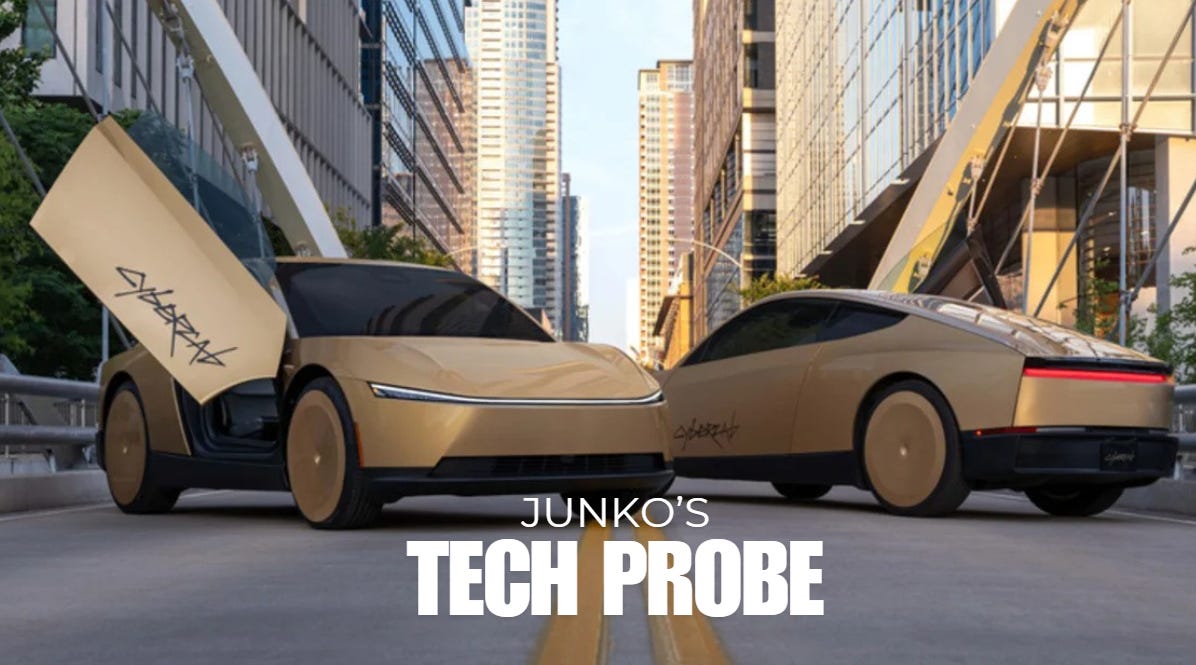
For the seasoned auto industry observer in America these days, it’s no surprise when, simultaneously, a company launches a new autonomous vehicle (AV), with no steering wheel, and safety regulators open an investigation into the safety compliance of the new model.
My case in point is Tesla’s Cybercab debut last week, swamped in media attention and Tesla fanboy adulation.
In the United States, carmakers self-certify that their vehicles comply with auto safety standards. So, on one hand, Tesla’s announcement is S.O.P.
Baked into the U.S. system is that a pre-launch safety certification by any third-party isn’t necessary, because vehicle manufacturers’ self-certification is deemed sufficient, all the while automakers get to tell us, “Trust us. Safety is our top priority.”
Nevertheless, the new vehicle remains subject to regulatory review. The hitch is that the National Highway Safety Administration (NHTSA)’s hands are tied and the agency doesn’t get to scrutinize new vehicles until models go commercial.
Looking through Japanese lens
Of course, I knew these rules. But I happened to be in Japan on vacation when Tesla’s Cybercab news hit the wire.
When I explained all this to my Japanese friends, they were all amazed: “Really? Do regulators let a company launch vehicles with no brake pedal and no steering wheel without any prior discussions?”
Well, such discussions may take place later, but not before the product launch.
In Japan, where I grew up, the rule is that domestic industries work with regulators throughout the product development process. The public tends to see value in consumers, companies and institutions conforming to regulations—notwithstanding a measure of political collusions. This is why the sequence of events in the Cybercab launch, preceding the first gesture of concern from NHTSA, struck me as surreal.
At first glance—and subsequent glances—that everyone in the United States appears to have understood a priori that Tesla would get away with this. Tesla launches vehicles without conventional manual controls, such as a brake pedal, gas pedal, steering wheel, that obviously do not conform to the Federal Motor Vehicle Safety Standards. Meanwhile, NHTSA is destined to get stuck with the challenge of herding Elon Musk’s Cybercabs after the company put them en massee on public roads.
Winning formula
U.S. tech companies have mastered a winning formula. They present issues like “safety,” “security” or “guardrails” as talking points, with proof of compliance derived from data that they have generated on their own behalf. They do this loudly. They get media coverage.
In a Silicon Valley culture in which slowing down innovation is a mortal sin, thumbing one’s nose at the feds, typified by Tesla’s preemptive Cybercab launch without waiting for regulation, is admirable chutzpah.
Phil Koopman, professor emeritus at Carnegie Mellon University, is convinced that Tesla could argue Cybercabs superficially comply with Federal Motor Vehicle Safety Standards. That in turn creates a window for Tesla to operate Cybercabs on public roads, thus “flooding the market.”
By the time either NHTSA or state authorities can catch up, the Cybercab, through sheer volume, becomes “too big to regulate.”
At this point, Telsa and NHTSA will both say that they are operating entirely within current law.
True. But let’s not forget that this is a familiar playbook for Tesla. The company finds a loophole in a system to advance its own vehicles. NHTSA, whose hands are tied, only gets to act later. There are no such things like pre-emptive actions taken by the regulator.
In my opinion, US media have become virtually numb to the tech industry’s cavalier attitude—“move fast and break things.” Circumventing federal regulations—either by finding lawful “loopholes” or actively violating or concealing non-compliance—is celebrated while the Feds play catch-up in developing safe AV performance standards.
The public cheers companies with the balls to oppose “deep state” regulators while corporations treat their stock prices—not products subject to planned obsolescence—as their most valuable asset.
Waiver?
I wonder why few in the media are asking if Tesla should have taken a more prudent path, working with NHTSA before the company’s Cybercab launch, rather than expecting a waiver afterward?
Why not cooperate? After all, there’s precedent.
Zoox, a division of Amazon, teamed with NHTSA in July, when Zoox won an exemption to put up to 2,500 of its vehicles on U.S. roads for two years.
Like Tesla’s Cybercab, Zoox vehicles do not have standard driver controls (no steering wheel).
Zoox and NHTSA talked in advance of launch, which resulted in NHTSA cutting red tape and allowing Zoox to commercially deploy its robotaxis. In fact, it took less than a year for Zoox to get the exemption from NHTSA.
Tesla could have done the same, but it chose not to bother.
Truth to be told, Tesla didn’t want an exemption. The company didn’t want NHTSA to cap the number of vehicles it can put on public roads. Further, Tesla didn’t want to put itself in a situation where the company would be required to report additional data to NHTSA.
For most unassuming consumers, regardless of where they live, it’s almost unthinkable that a government tasked to ensure public safety would, for example, allow a drugmaker to release untested meds.
By the same token, shouldn’t consumers be able to expect vehicles blatantly violating the Federal Motor Vehicle Safety Standards not to be allowed on public roads?
But apparently, for the auto industry in the United States, that expectation is moot.
We’ve stopped talking about the benefits of regulation. The government trusts tech bros. It’s evident that an industry whose technology and engineering prowess have been long admired both for ingenuity and probity has succumbed to a tech-bro oligarchy for whom marketing is more important than intellectual honesty.
At the same time, Tesla makes extraordinary and unprecedented demands on public safety officers and fire fighter equipment, behavior, and training to support Cybercab operation, but not the needed cash. Once again, Tesla assumes the uncompensated support of taxpayers without any comparable public benefits. For more on this, listen to https://rss.com/podcasts/autosafety/3137776.
I think you have completely mischaracterized situation.
Tesla and NHTSA have a long history of working well together. NHTSA has been very clear, they are working hard to update their rules and guidelines to support technology progress in driverless vehicles, without brakes, steering wheels or mirrors. Working with Tesla, the leader here, is obviously a key part of that.
So they have simply reached out for more information. Happy to see that. There will be a process that is highly unlikely to affect Tesla, or CyberCab users in any significant way.
Tesla is not using a loophole, and NHTSA hands are not tied. Tesla are not blatantly violating the Federal Motor Vehicle Safety Standards. NHTSA have known for a couple of years what Tesla is doing, and are trying to keep up with regulations to support that.
Yes Japan and Europe, both have some obstructive bureaucracy, that limits innovation and progress, and they have fallen way behind on the technology advancements in electric vehicles as result.
The US approach of embracing new technology and innovation and supporting it through developing legislation with a teamwork approach, will have much better results overtime, with little risk.