


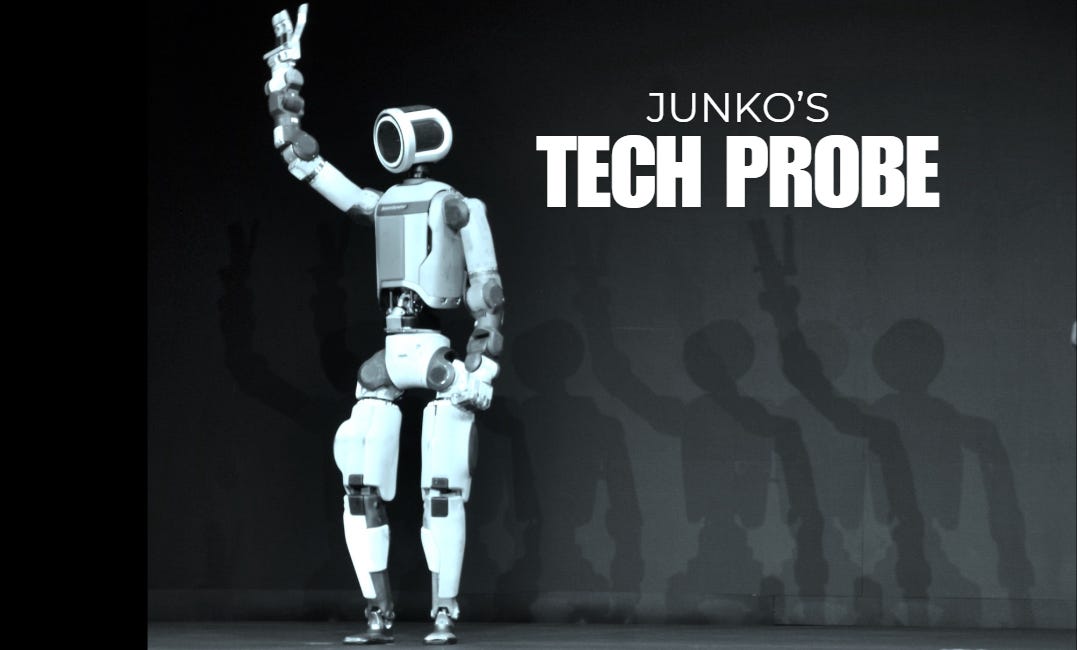
Hyundai’s humanoid Atlast on stage at CES 2026 (Photo: David Benjamin)
Significantly absent from this year’s Consumer Electronics Show (CES) keynote speeches was the once obligatory mention of “sustainability.”
In like a lion, instead, is “Physical AI.”
In his Monday keynote, Nvidia’s CEO, declared, “Chat GPT moment for physical AI is nearly here.”
Incanting the new moniker “Physical AI,” CES attendees found robots on all floors in every exhibition hall of the Las Vegas Convention Center. There were humanoids who can walk like John Wayne (Hyundai), home robots who fold an entire bath towel in fifteen minutes (LG), and many robots that can execute a backflip.
Human dexterity has been singled out as a huge challenge for humanoids by many roboticists. (See Rodeny Brooks essay,’ “Why Today’s Humanoids Won’t Learn ")
So, several companies attempted to claim progress in this area. Japan’s XELA Robotics unveiled a robotic hand equipped with—the company said—improved tactile sensor technology. Sharpa also showcased what it calls “Autonomous Full-Body Robot with Human Dexterity.”
Big fail
Attendees also saw a big fail.
A tall, imposing humanoid accidentally fell on its “face” at one robotic booth. Nobody got hurt but a viral video of the collapse is a clarifying reminder that robots intended to be used at home could be harmful to small children and other living things.
“Once you have a robot not inside a locked cage, you have a safety problem you’re going to have to deal with,” said Phil Koopman, safety expert and professor Emeritus at Carnegie Mellon University.
The concepts of safety and security in the digital world are typically abstract for consumers. However, when Physical AI, in humanoid form, starts to proliferate, potential threats created by robots become suddenly relatable, pressing issues.
Driving forces
Several factors have pushed the robotic movement to a fever pitch.
First is the rapid advancement of AI. Rather than developing single-task robots, system designers today dream of a general-purpose robot that can perform many tasks “autonomously.” They find promise in end-to-end (E2E) AI learning, as they see it as the technology that underpins physical AI.
Instead of traditional rule-based AI which requires the arduous labeling of each object with manual updates, E2E AI learning brings in all the pixels (raw sensor inputs) and throws them into one big machine-learning system for direct output (actions or decisions). The machine learns patterns from massive datasets.
Designers of Physical AI or Embodied AI, which strive to build real-world understanding through physical interaction and experience, appear to be saying, “Feed a whole bunch of videos to robots, show them how humans use their hands and legs, and stand back while they learn.”
Koopman, whose new book is “Embodied AI Safety,” cautioned, “With end to end, it’s much easier to get something up and running. But it’s probably harder to deal with heavy tail-edge cases.”
At a press conference, Hyundai explained that it is giving robots “simple language instructions” for simple tasks while the robots “learn from their experience” how to “react to any unexpected things” by employing the power of E2E AI learning.
Second, never ignore the Nvidia factor. The GPU giant brought to Las Vegas new open models, frameworks and AI infrastructure for physical AI. Nvidia announced the use of its robotics stack, for AI-driven robots, by Boston Dynamics, Caterpillar, Franka Robotics, Humanoid, LG Electronics and NEURA Robotics.
The third factor is the belief that Physical AI/Embodied AI systems pose a massive business opportunity. If Uber’s CEO sees robotaxis as a “trillion-dollar-plus” business,” imagine the size of the potential market of embodied AI systems that go far beyond autonomous vehicles.
Embodied AI systems contain a physical presence to directly interact with the real world, through sensors, actuators, MCUs, microprocessors and connectivity technologies. Tech suppliers see a market too big to pass up.
Fourth, many startups who initially bet big on autonomous vehicles are pivoting from automotive to robotics in the industrial and defense markets. They need Physical AI to drum up investor interest in their technologies. LiDAR companies like Voyant and MicroVision are already at the million-dollar window posting bets on Physical AI.
Challenges
While demonstrating impressive progress and big promise, autonomous vehicles are also revealing a glimpse of hard reality.
Robotaxis, for example, do not operate without an Operational Design Domain (ODD). Nor are they free of the teleoperators who remotely make decisions and corrections when the cars get confused.
Given the surprises inherent in the physical world, imagine the challenges for home robots trying to navigate a far more random, undefined space in a cluttered home.
Humanoids are often pitched as an “elder care” panacea. But what if the live-in cyborg emptying your aging mother’s bedpan fell on her? Will C3PO’s manufacturer assign remote operators to lift him off Mom?
Indeed, Ali Ors, director of AI ML strategy and technologies and edge processing at NXP Semiconductors, acknowledged “a lot of parallels between automotive and robotics.”
But, he added, “In a sense, robotics is sometimes harder due to the diversity in [robotic players].” Companies must deal with different needs, preferences in system architecture and bottlenecks. For example, a robot with only one big brain “might not make sense,” said Ors. It might need extra brains to deal “with latency issues.”
Even when a big brain is intelligent enough to identify what your robotic hand has picked up, it’s a challenge to inform the hand, for example, that the egg it just grabbed can’t be squeezed. By the time the message filters through, “your robotic hand has cracked the egg.”
If you are a sensor company pursuing robotics in the industrial market, you need to deal with a lot of customization, noted Srimannarayana Baratam, co-founder and director of operations at Perciv.ai. The key is to leverage flexible software before throwing more sensor hardware at robots.
At his CES booth, he said that the key in the industrial field is “to make software as adoptable as possible and do it quickly.” The Netherlands-based startup which has developed AI software primarily dedicated for radar perception is also working on AI-driven radar and radar-camera fusion software.
Security is another big challenge. Nagra/Kudelski Group, a cybersecurity provider, demonstrated at CES how to add to a robotic dog much needed security, or even a safety feature like a kill-switch. Using a Chinese knock-off Boston Dynamics look-alike, the Kudelski Group demonstrated a small piece of hardware attached to the dog’s back. The hardware unit, directly connected to the robotics’ API, runs the company’s security software stack.
Although Kudelski has no intention of selling this hardware, it stressed the significance of enabling security features such as managing credentials, and featuring device lifecycle management for embodied AI systems
Why Nvidia reins Physical AI
Among tech players today, Nvidia owns the AI narrative.
Setting itself apart is Nvidia’s mastery of many technologies essential to enable Physical AI/Embodied AI.
Nvidia’s CEO sees the ultimate challenge of Physical AI is to build a system — for vehicles, robots, factories, or any embodied AI that interacts with the world — that can understand the “common sense” of how the world works.
In his keynote, Huang laid out three computers to enable this.
Nvidia built one computer to train AI models and another for inferences. The third is designed for simulation.
Huang noted that simulation is “where we at Nvidia are most comfortable. Simulation was the foundation of almost everything that we’ve done with physical AI.”
Key to simulation is Omniverse, Nvidia’s digital twin in a physically based simulation world. Cosmos is Nvidia’s foundation model, “not a foundation model for language, but a foundation model of the world, and is also aligned with language,” said Huang.
Nvidia also offers two robotics E2E AI learning models: GR00T (Generalist Robotic Transformer) focuses on humanoid robotics. Alpamayo, an E2E AI learning system enables Autonomous vehicles (AV).
The most important aspect of Nvidia and AI is that Nvidia doesn’t make robots. Although it started as a chip company, it is no longer just a semiconductor supplier. Huang’s genius is that his company has figured out multiple ways to skin the AI cat.
Clients interested in Physical AI can opt for various combinations among Nividia’s offering, whether software, AI learning models, AI chips or AI computers. While Nvidia occupies a position that makes it impossible to lose in the business of Physical AI, anyone else plunging headlong into building physical AI systems could find themselves held accountable if their systems go haywire.
“Don’t overthink it, just do it” might be the byword for the exploration of Physical AI.
But when an AI-driven product can harm someone — there are plenty of hypotheses for this eventuality— you need a better plan than telling people, “the system will eventually learn by itself.” You need more assurance than promising that “we will iterate our software and update it over the air.”
Related story:
If Tesla Loves E2E AI Learning, Why Shouldn’t Everybody?

Trust most new technologies. If they sound too good to be true, they’re probably too good to be true.