


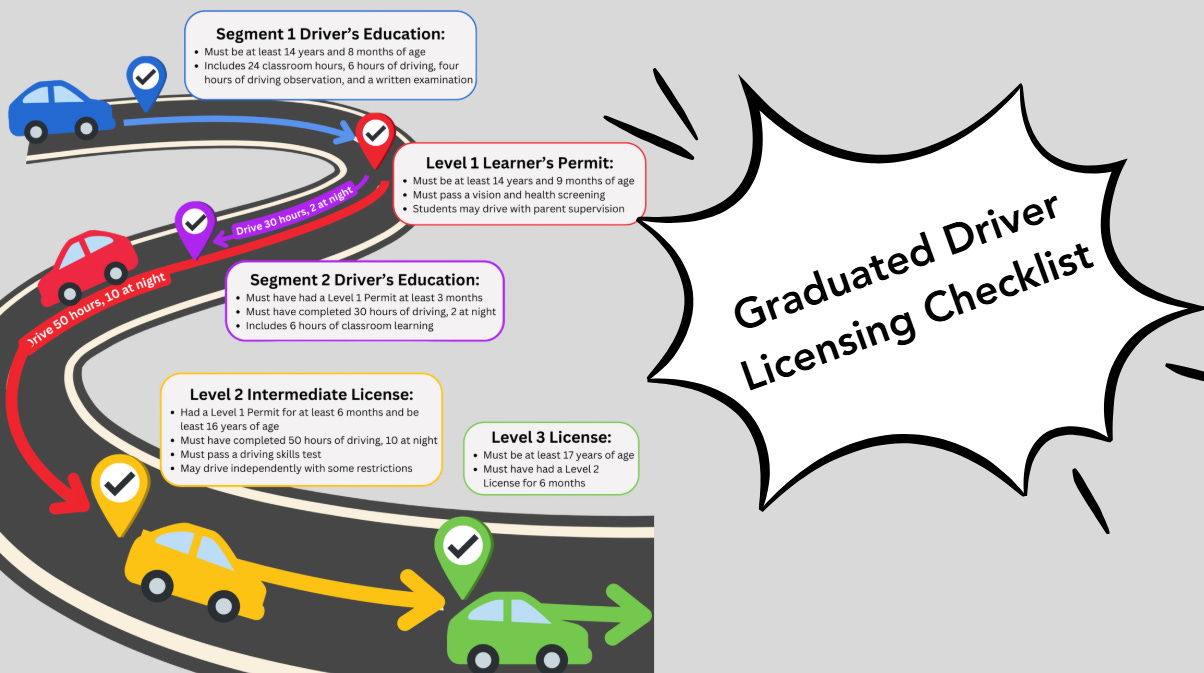
America already has a model for letting risky new capabilities mature in public: graduated licensing for teenagers.
A sixteen-year-old who passes a road test is not handed the keys to go anywhere, anytime, with a car full of friends. The law gives new drivers room to learn, but not unlimited freedom. It is not a ban. It is not blind trust. It is responsibility earned in stages.
Robotaxis are the visible edge of a much larger governance problem: how do we let high-risk AI systems improve in public without giving them unlimited freedom before they have earned it?
In transportation, they are already the test case. As I previously argued, they should earn more room to operate as evidence of improved capabilities accumulates and face tighter limits when it does not. That is the basic principle policymakers should apply to high-risk AI: broader authority should be earned, not assumed.
The Car Is No Longer Finished at the Factory
A car used to be largely finished when it left the factory. Now it keeps changing through software updates. Features can be added, revised, or limited. Driver-assistance and automated systems can behave differently a year after you bought the car.
Traditional automotive regulation was built around a more stable product. The U.S. relies largely on manufacturer self-certification; Europe uses type-approval before vehicles enter the market. Safety ratings pushed beyond legal minimums by making performance visible to buyers. But all of these methods strain when the product keeps changing.
One-time approval cannot keep up. A software update can fix one problem and create another. In one of our naturalistic studies, the driver-assistance system kept changing through dealer updates, and driver behavior differed across the versions—some groups of drivers took their hands off the wheel and looked away from the road more than others. A one-time, pre-launch test would never have caught those differences.
This is not a hypothetical governance problem. The product changes, the user adapts, and the safety case evolves after deployment.
Safety Cannot Stop at the Factory Gate
If these systems are designed to reduce harm, they should be judged through something closer to a public-health lens.
Medicine has wrestled with versions of this problem for more than a century. Today, the FDA relies on staged evidence and post-market monitoring because some risks surface only at scale. The FAA treats safety as an ongoing operational problem, not just a one-time judgment. It oversees certification, training, maintenance, reporting, and the authority to restrict operations when risks emerge. Vaccine law adds the liability lesson: Congress created a no-fault compensation program that speeds routine claims but stops short of blanket immunity.
The warning for AI and automated vehicles: if companies ask the public to simply trust them, they should not be surprised when policymakers reach for more prescriptive oversight. A lighter, evidence-based path depends on making performance visible before public confidence erodes.
Cars are not drugs, aircraft, or vaccines. The analogies are imperfect. The goal is not to copy any one model, but to borrow the logic: staged evidence, lifecycle accountability, and liability rules that recognize both public benefit and preventable harm.
The Third Path
A graduated model would not have to replace self-certification or type approval. It could sit alongside them as an optional path for systems that continue to change after deployment.
Companies that choose this path would accept greater obligations: sharing evidence, tracing updates, monitoring performance, and fixing problems as data warrants. A company that shows its work should be treated differently from one that simply asks to be trusted.
Legal scholar Bryant Walker Smith has argued that trust depends not only on whether automated vehicles are trustworthy, but on whether the companies behind them are. A graduated pathway forces that question into the open.
A system might start in narrow conditions, with supervision, reporting requirements, and clear limits. If performance is stable, it earns more room. If warning signs appear, the room narrows before anyone gets hurt.
For vehicles, that might mean staged operating domains, performance reporting, independent audits, and clear authority to pause deployment when the evidence deteriorates. Other AI systems could follow similar tiers of access, autonomy, and accountability. The rule of thumb is simple: the higher the stakes, the more a company should have to prove.
Liability should follow the same logic. No blanket immunity just because innovation is valuable. But a company that stays within tested limits, shares evidence, and fixes problems should have that count for something in court. If it withholds data, ignores warning signs, or misrepresents performance, protections should narrow. Negligence, deception, and recklessness still belong in a courtroom.
A system like this doesn’t make harm vanish. It draws the line society actually cares about: between risk handled responsibly and harm that never had to happen. That is the larger AI-governance problem in miniature: how to build guardrails that don’t freeze progress.
Too often, regulation is treated as a binary choice: government either gets out of the way or writes broad rules that are obsolete before the ink dries. A graduated-permission model offers a third path. Regulators need not predict every future use case. Companies must demonstrate performance as they seek broader authority.
Approval can’t be the last serious look. Graduated licensing did not make teenagers perfect drivers. Clinical trials did not make medicine risk-free. Aviation oversight did not eliminate failure from flight. What these systems share is something more practical: they made learning visible, staged, and accountable. Automated and software-defined vehicles need the core elements of this structure. So will many high-risk AI systems. The learner’s permit is not a brake on progress. It is how trust gets earned.
—Guest columnist Bryan Reimer is a research scientist at MIT and co-author of “How to Make AI Useful.” His work focuses on how artificial intelligence and automation shape real-world systems, and he advises industry and policymakers on their deployment. This piece is co-posted by Reimer on LinkedIn.
