


(Image: Nvidia)
The headline is misleading.
My invitation-only interview with Nvidia’s CEO Jensen Huang, in a ballroom at the Fontainebleau Hotel at the Consumer Electronics Show wasn’t exactly a cozy tête-à-tête. Instead, I was among 200 reporters and analysts gazing up at Huang, standing alone on a stage.
However, these ninety minutes with Huang were exceptional in one respect.
Most corporate bigwigs these days appease the media by setting up a “fireside chat” to field softball questions … and then they take no questions.
In contrast, the CEO of a company whose market cap is at $4.5 trillion patiently answered sometimes irrelevant questions from the media, although with the usual quota of evasion and fudging. Mostly, he was cordial and respectful. And for moments, he even seemed to be enjoying himself.
Nvidia did not want reporters to post a full transcript or video of the session, so I’ve picked several key questions – which I thought mattered –to share here. Huang’s answers reveal him at his best, as a deft thinker and gifted speaker.
On retirement
Q: What’s your secret to being the longest serving CEO of your stature? Do you have another decade in you?
Jensen Huang: The secret for being CEO for this long is one, don’t get fired, and two, don’t get bored. I don’t know which comes first.
[As] for how long, as long as I deserve it … There is a great responsibility in being the CEO at Nvidia. We are the captain of this industry, and we have supply chain partners and collaboration partners all over the world who are counting on us.
It took us almost 34 years to get here. We’re getting good at it. So, if you do something for 34 years, even I can figure that out.
On TSMC
Q: You just said six new Nvidia chips that are coming out. How do you work with TSMC to ensure stable capacity and timely delivery?
[Editor’s note: the six new chips referred here include: Vera CPU, Rubin GPU, NVlink 6 Switch, ConnectX-9 SuperNIC, BlueField-4 DPU and Spectrum-X Ethernet Switch.]
Jensen Huang: The answer to your question is “very carefully.”
We’ve been working with TSMC for almost 30 years. Our planning departments at the two companies work very closely together. They’re literally updating each other every single week, every single day.
So, to get six chips all into production, and those are not the only chips we have [working with TSMC], as we still have Grace, Blackwell, GeForce, RTX Pro, Thors, Orins and all kinds of different chips.
I know Vera Rubin [platform] is very challenging, because all the chips are brand new, using the latest process technology. And it even uses a new silicon photonics technology [for Spectrum-X Ethernet Switch] called COUPE.
On Tesla’s Full Self Driving (FSD)
Q: How does Alpamayo – Nvidia’s newly announced end-to-end (E2E) AI models – stack up against Tesla’s FSD?
Jensen Huang: Tesla’s FSD stack is completely world class. They’ve been working on it for quite some time. It’s world class not only in the number of miles it has, but in the way it’s designed, trained, to data collection and curation, synthetic data generation and all of their simulation technologies.
Of course, [Tesla’s] latest generation is end-to-end full self-driving, meaning just one large model is end-to-end training. And so Elon’s AV system is, in every way, 100% state-of-the-art. I’m really quite impressed by the technology.
Q: Where does Nvidia’s solution differ from that of Tesla?
Jensen Huang: Nvidia doesn’t build self-driving cars. We build the full stack and the technology for everybody else to build self-driving cars.
We have built computers here: the training computer, the simulation computer, and also the self-driving car computer. We have software stacks across all of them. Our customers can use all of it, or some of it, parts of it…. whatever makes sense.
So, we’re working with the entire automotive industry, everybody from Tesla for their training system and Waymo for the car computer, to Nuro, Lucid and Uber who just unveiled a global robotaxi business using Nvidia’s AI computing platform (Drive Thor).
So, our system is really quite pervasive, because we’re a technology platform provider.
On memory chips
Q: The secondary effect of demand for AI is a shortage of memory, and that’s making the price of game machines go up right now. Do you wish to buy a DRAM factory?
Jensen Huang: You guys don’t know this, but Nvidia is one of the largest direct purchasers of memories in the world. We work with every memory supplier, and some of them are being built for HBM. Thank goodness we’re the only user of HBM, and we’re not expecting anybody else to be using HBM for some time.
Because our demand is so high, every HBM factory and supplier is gearing up, and they’re all doing great. We also purchase GDDR for our graphics cards, and we’ve been a large, very significant GDDR consumer for a very long time. So, we’ve been planning that out with all of our suppliers for quite some time.
And then, we’re also a purchaser of LPDDR5X memory for the Vera Rubin AI platform. We are grateful for all the memory suppliers supporting us and doing a fantastic job.
On AI factory -- instead of a data center
Jensen Huang: In memory production, in the final analysis, the fact is the world’s going to need more fabs. The reason for that is because of this new industry called “AI factories.”
The reason I say AI factory instead of data center is that data centers have existed for a long time. AI factories are a brand-new category and this new category, which Nvidia really started, has never existed before.
This segment of the world’s infrastructure called AI factories is going to be gigantic… It’s great to be a memory supplier. It’s great to be a semiconductor manufacturer. TSMC is doing great, and the demand out there is really quite terrific.
On humanoids
Q: I know you’re excited about physical AI, but the robots on the show floor are often rudimentary. When do you think we’re going to get robots that actually have human level capabilities.
Jensen Huang: Next year… no, this year, because I know how fast the technology is moving.
You know, there is some extremely hard stuff. Fine motor skills is extremely hard … building a hand is hard, and the motor technology is hard.
We don’t just use our eyes; we also use touch. The robot only has eyes, so it needs to have touch. Those fine motor skills are hard to develop, but we’re developing technology in that area, and I know the rest of the industry is doing so.
Locomotion is hard, but that’s making incredible progress. I think locomotion is going to be the first to get solved.
Gross articulation and grasping will be the second, and third will be fine motor skills. They are not in that sequence, but in degree of difficulty.
The rest, like cognition skills are evolving very quickly.
On embodied AI
Jensen Huang: We’re going to have really great reasoning AI models that are resident inside the robot. The robot will be able to reason very quickly, and [if it needs] to tap the AI in the cloud for additional knowledge, it can.
I will say these AI models are human-origin nature. But don’t forget, when you’re humanoid and sit inside a car, somehow you embody the car. You’re able to steer the car like it’s an extension of you.
When you pick up a tennis racket, you embody the tennis racket. Somehow your arm got longer. So, the ability for AI is to become multi-embodiment, meaning we train an AI model to be a humanoid.
On H200 and China
Q: You said you are ramping up production of H200, and demand is high. You also said that you are working on the final details of licensing with the Trump administration. Do you have any evidence or assurances about the Chinese government approving any purchases yet of H200s by Chinese companies?
Jensen Huang: I’m not expecting any declaration from the government. I’m only expecting purchase orders. And when the purchase orders come, it is going to imply everything else. They have to follow their rules, they have to follow their laws, and we have to follow the laws. And so my sense is that when the purchase orders arrive, they’ll speak for themselves.
Q: When are you expecting to have the first purchase order?
Jensen Huang: Well, I expect shortly after we get the licenses. President Trump has already said that the H200 are licensed to be exported. Now we must go through getting all the mechanics done. And the administration is working super hard. [The] Commerce [Department] is working super hard to get all of that put together. Once we get that done, I’m expecting purchase orders to arrive.
Q: Do you think H200 is still competitive in the Chinese market? You said yourself that Huawei is a formidable competitor, and there are many startups in China working on alternatives.
Jensen Huang: H200 is competitive in the market. It won’t be competitive forever.
So, H200 now, hopefully, later, we’ll be able to release other competitive products. But that’s basically what we need to do in order to keep the United States competitive. We will have to continue to evolve, and a static regulation doesn’t make sense.
Q: So are you saying Blackwell and Rubin will be allowed into China in time?
Jensen Huang: In time, it makes sense. It doesn’t make sense now, but when H200 will no longer be competitive, hopefully we’ll have something else new.
On Jensen’s leather jacket
Q: Could you give me your roadmap to change your leather jacket?
Jensen Huang: It’s somebody else’s roadmap, I just wear it.
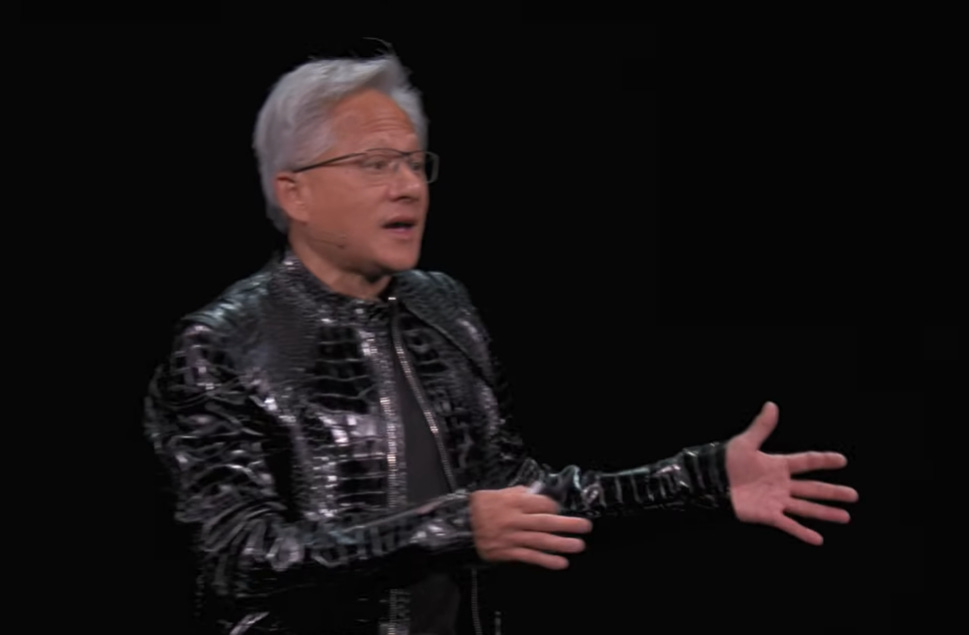
Huang, known for his trademark leather jacket, wore the shiney one above at his CES 2026 keynote. (Image: Nvidia)
Related stories:

Get That Robot Off My Mother!

Hyundai’s humanoid Atlast on stage at CES 2026 (Photo: David Benjamin)
Among the Silicon tech-bro billionaires, Jensen shows the fewest symptoms of serious mental illness. Maybe he should fund a rehab facility for the other guys.